
If you are still figuring out your taxes in March in a panic — you are not alone. But here is what is changing: millions of Indian taxpayers are now using global AI tools to plan their taxes smarter, earlier, and with far more clarity than before. And with the sweeping changes that Budget 2025 introduced — including revised tax slabs under the new regime, an increased standard deduction, and updated capital gains rules — 2026 is the year you actually need that clarity.
Tools like ChatGPT (GPT-4o), Claude, Perplexity AI, Google Gemini, and Microsoft Copilot have quietly become some of the most useful AI tools for tax planning companions available to Indian taxpayers. They are not chartered accountants — and they should not replace one for complex matters — but for scenario modelling, deduction discovery, and year-round planning, they are genuinely excellent.
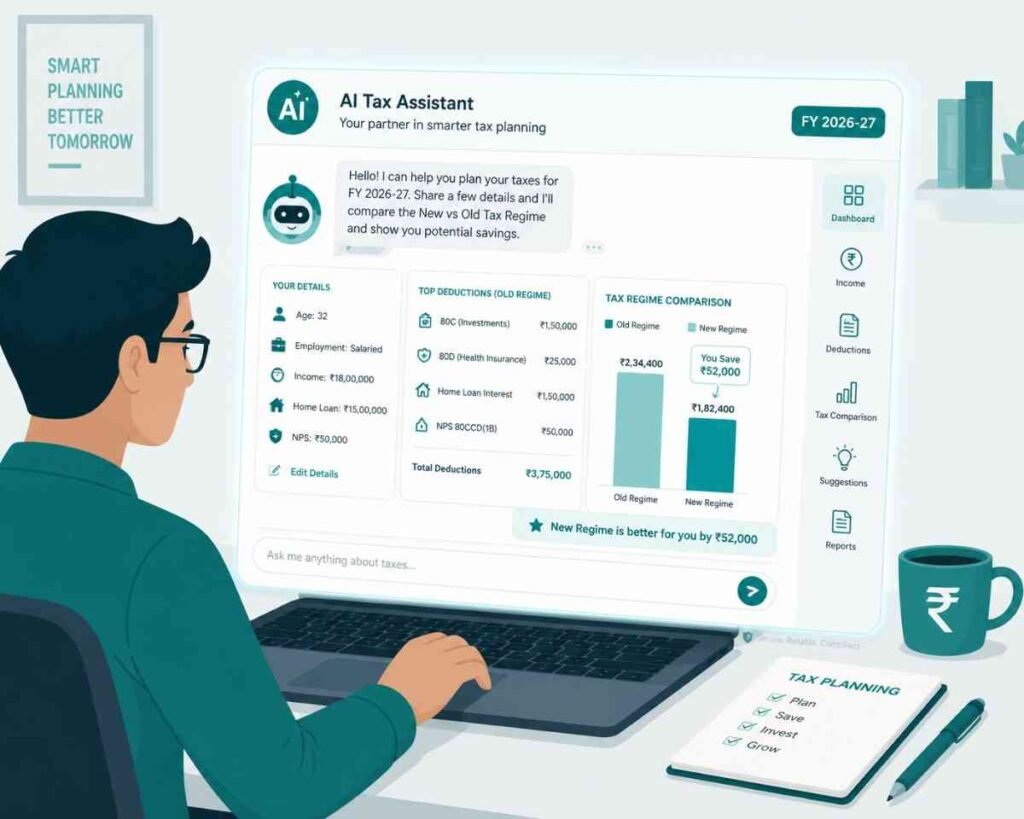
This guide will show you exactly how to use them for FY 2026-27, what has changed in the current tax year, and where AI tools help most.
What Changed in FY 2026-27 That Makes This More Relevant
Budget 2025 (presented in February 2025 and effective from FY 2025-26 onwards, now fully in play for FY 2026-27 planning) brought meaningful updates that affect how most salaried Indians should approach their taxes:
- The new tax regime now offers a standard deduction of ₹75,000 — up from ₹50,000 previously
- The zero-tax threshold under the new regime was raised to ₹12 lakh of net taxable income (with rebate under Section 87A)
- Revised tax slabs under the new regime make it more attractive for a broader income range
- The old regime remains available but is now the opt-in choice — new regime is the default
- Capital gains tax rules revised: LTCG on equity above ₹1.25 lakh taxed at 12.5% (up from 10%); STCG at 20%
- Indexation benefit on real estate LTCG was removed for properties purchased after a specified date
These rules are based on Budget 2025 announcements. Always cross-verify with the latest CBDT circulars or a qualified CA before making financial decisions — rules can be further amended through notifications.
All of these changes create new decision points — and AI tools are genuinely useful for navigating each one.
The Best Global AI Tools for Indian Tax Planning Right Now
Not all AI tools are equally useful for every tax task. Here is how each stacks up in May 2026:
Best all-rounder. Strong at regime comparisons, deduction checklists, and step-by-step calculations. Use it with the Code Interpreter for spreadsheet-style tax modelling.
Excellent for long, nuanced conversations — ideal for self-employed individuals or those with complex income sources. Handles multi-part queries very well.
Best for real-time research with citations. Pulls from CBDT press releases, PIB notifications, and financial news — great for verifying Budget 2025 rule changes.
Integrates with Google Sheets for building live tax calculators. Useful for tracking capital gains and investment amounts across the financial year.
Solid choice for corporate employees who use Excel. Helps model Form 16 data, HRA calculations, and salary restructuring scenarios in familiar spreadsheet format.
6 Practical Ways to Use AI for Indian Tax Planning in FY 2026-27
1. Deciding Between Old and New Tax Regime
This is the single most impactful tax decision for most salaried Indians — and it is highly personal. The new regime is now the default and works well if your deductions are low. The old regime is better if you have a home loan, significant 80C investments, and HRA exemptions. AI tools can model both scenarios in under a minute.
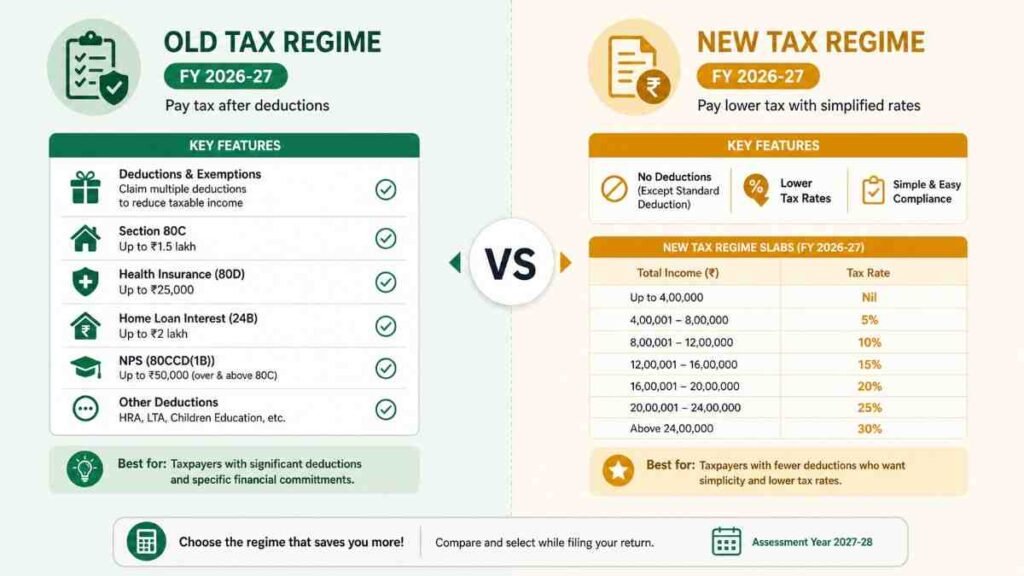
Use a prompt like this:
“My gross salary is ₹16 lakh for FY 2026-27. I have: ₹1.5L in Section 80C, ₹50,000 in NPS (80CCD(1B)), ₹25,000 in health insurance (80D), ₹1.8L in home loan interest, and I claim HRA of ₹96,000. Standard deduction is ₹75,000 under new regime and ₹50,000 under old. Which regime saves me more tax? Show a comparison with final tax payable.”
Claude or ChatGPT will produce a clear side-by-side table. More importantly — you will understand why one regime wins for your specific situation, not just that it does.
2. Tracking Deductions You Are Missing
Most salaried taxpayers know about Section 80C — but consistently miss deductions they are entitled to. AI tools serve as a comprehensive, patient checklist that will not judge you for not knowing.
Common missed deductions AI tools help identify:
- Section 80D: Health insurance premiums for self and parents — up to ₹25,000 + ₹50,000 for senior citizen parents
- Section 80E: Education loan interest (no upper limit, available for 8 years)
- Section 80G: Approved charity donations — some offer 100% deduction
- Section 80TTA / 80TTB: Savings account interest (₹10,000 limit; ₹50,000 for senior citizens)
- Section 80EEA: Home loan interest for affordable housing (check current eligibility)
- LTA (Leave Travel Allowance): Available under old regime with actual travel proof
Ask AI: “Give me a complete checklist of all income tax deductions available to a salaried Indian in FY 2026-27 under the old regime, with limits and eligibility conditions.” Then map it against your actual expenses.
3. Capital Gains Tax Planning Post-Budget 2025
With LTCG on equity now at 12.5% (above ₹1.25 lakh threshold) and STCG at 20%, the stakes of when you sell your mutual funds or stocks have increased significantly. AI tools can help you think through the timing of redemptions to minimise tax.
For example, if you are planning to redeem equity mutual funds, you can ask: “I have equity mutual fund units worth ₹4 lakh with a cost of ₹2.5 lakh, purchased 18 months ago. What is my capital gains tax liability in FY 2026-27? Should I stagger the redemption across two financial years to reduce tax?” The AI will walk through the maths and the logic.
For real estate capital gains and the removal of indexation on newer properties, use Perplexity AI specifically — it can retrieve the most current CBDT guidance with source links, reducing the risk of acting on outdated information.
4. Building a Section 80C Strategy That Actually Makes Sense
If you are using the old regime, the ₹1.5 lakh Section 80C limit still needs to be deployed wisely — not just stuffed into the nearest LIC policy. AI tools can help you build a portfolio-style 80C strategy based on your goals.
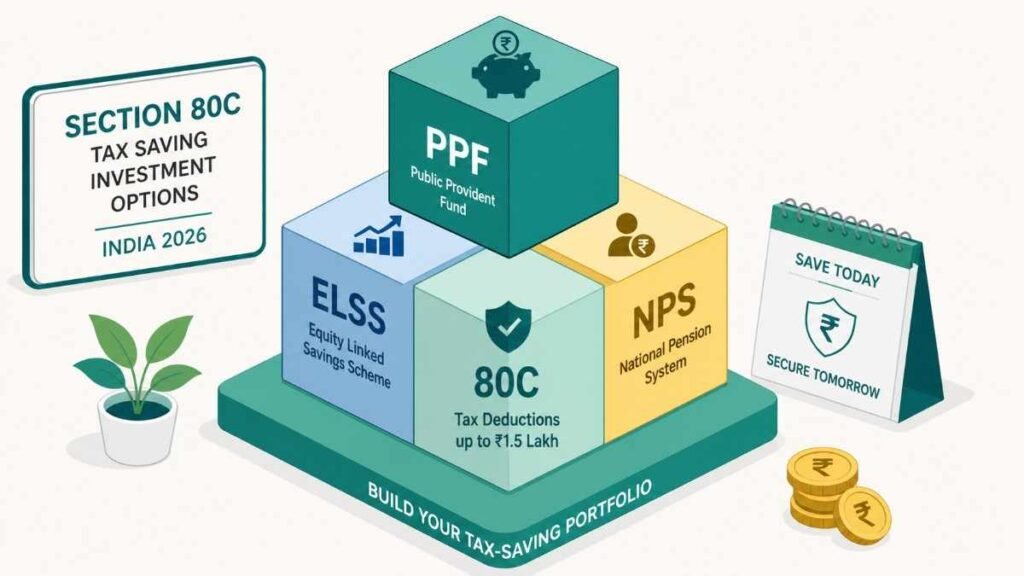
Ask: “I am 32 years old, moderate risk appetite, 30% tax bracket. How should I allocate my ₹1.5L Section 80C investment between ELSS, PPF, and EPF? What are the liquidity and return trade-offs?” You will get a thoughtful framework — the kind a good financial advisor would give you — in seconds.
5. HRA Exemption Calculation
HRA exemption remains one of the most frequently miscalculated benefits for urban salaried employees. The exemption is the minimum of: actual HRA received; 50% of basic salary (metro cities) or 40% (non-metro); and actual rent paid minus 10% of basic salary.
Just input your numbers and ask any AI tool to calculate your HRA exemption step by step. You may discover your employer’s salary structure is not optimised — and AI can suggest how to approach an HR restructuring conversation.
6. NPS and Employer Contribution Planning
The National Pension System offers one of the most tax-efficient deductions available — Section 80CCD(1B) gives you an additional ₹50,000 deduction over and above the 80C limit, even under the old regime. Under the new regime, employer NPS contributions (up to 14% of salary for central government employees, 10% for others) remain deductible.
AI tools can model exactly how much additional NPS contribution reduces your tax, and whether the liquidity trade-off (NPS locks funds until retirement) is worth it at your income level.
How to Use AI Tools Safely and Effectively
AI tools are excellent research and modelling partners — but they need good inputs to produce good outputs. A few principles to keep in mind:
- Be specific: give your actual income, deduction amounts, and the financial year. Vague questions get vague answers.
- Always verify tax rates and slab changes from CBDT or a CA — AI training data has cutoffs and may not reflect amendments made after a certain date.
- Do not share sensitive personal data like PAN, Aadhaar, or bank account numbers with any AI tool.
- Use Perplexity AI when you need cited, current source information rather than reasoning-based answers.
- Treat AI output as a starting framework — not a final filing instruction.
The Smart Annual Tax Planning Workflow
The biggest mistake Indian taxpayers make is treating tax planning as a March problem. AI tools make year-round planning effortless. Here is a month-by-month rhythm that works:
- April–June: Use AI to finalise which regime you are opting for FY 2026-27. Inform your employer for TDS purposes.
- July–September: Track any capital gains from mutual fund SIPs. Ask AI to model your running tax liability.
- October–December: Review your 80C investment gap. Use AI to identify deduction opportunities before year-end.
- January–February: Use AI for final tax projections. Make any last 80C, NPS, or health insurance contributions.
- March–July: Work with your CA for accurate ITR filing using the groundwork done all year.
Here is my honest take after using AI tools for tax planning through two full financial years: the biggest shift is not in saving more tax — it is in understanding your own finances clearly. When you can ask a question at 11pm on a Tuesday and get a reasoned, step-by-step breakdown of why your home loan is not helping your new regime calculation, you stop feeling confused and start feeling in control. That confidence is worth more than any single deduction. Use AI to learn, verify everything important with a professional, and stop waiting until March to think about your taxes.
Also Read: I Used Ai Tools instead of working for 30 Days – Here’s the truth
Frequently Asked Questions
Can AI tools file my ITR for FY 2026-27?
No. AI tools cannot access the Income Tax e-filing portal or submit returns on your behalf. They are useful for planning, calculation, and preparation — but actual ITR filing must be done through incometax.gov.in or via a registered tax practitioner.
Is the new tax regime better for everyone in FY 2026-27?
Not necessarily. The new regime is better for those with limited deductions and lower incomes (especially those earning up to ₹12 lakh, who benefit from the full Section 87A rebate). Those with significant home loan interest, HRA, and 80C investments may still benefit from the old regime. AI tools can model your specific case in under a minute.
Which AI tool is best for Indian tax queries in 2026?
For general planning and regime comparisons, ChatGPT (GPT-4o) and Claude are excellent. For real-time verification of Budget 2025 rule changes with source citations, Perplexity AI is the most reliable. For Excel-based modelling, Microsoft Copilot works well.
Is it safe to share my financial details with AI tools?
You should never share sensitive identifiers like PAN, Aadhaar, or bank account numbers with any AI tool. For planning purposes, use approximate income and deduction figures — AI tools do not need exact personal data to produce useful analysis.
Can AI tools help with capital gains planning after the Budget 2025 changes?
Yes — AI tools can model your capital gains tax liability, help you understand the 12.5% LTCG and 20% STCG rates on equity, and suggest redemption timing strategies. For real estate capital gains and the removal of indexation on newer properties, combine AI reasoning with Perplexity AI’s cited sources for current accuracy.
Related Post: AI Robo Advisors in India