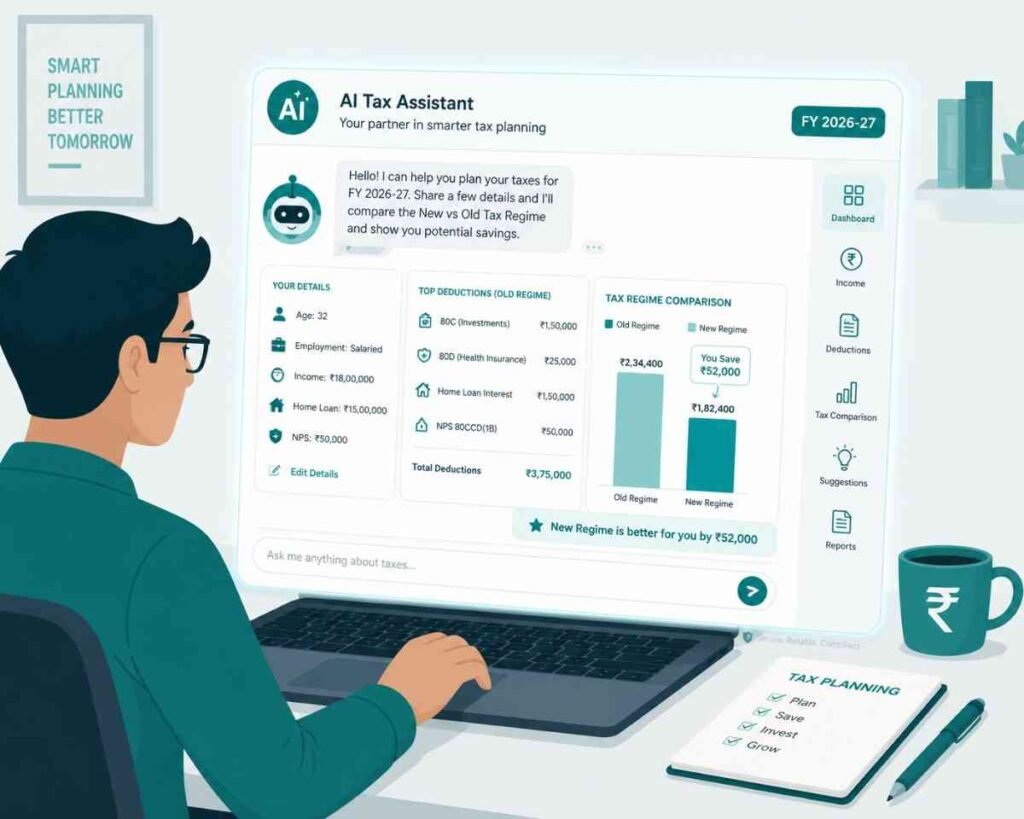

You open your salary account on the 1st. By the 5th, you’ve already paid rent, groceries, and an EMI. What’s left barely feels worth investing. And when you do think about investing, the sheer number of choices — mutual funds, stocks, ETFs, SIPs, ELSS — can feel paralyzing.
What if an AI could handle all of that for you, automatically, for less than the cost of a cup of coffee a month?
That’s exactly what AI robo-advisors do. In 2026, they’re no longer a futuristic concept. They’re real, SEBI-regulated platforms handling billions of dollars in assets across India — and they’re growing fast. Assets under management in India’s robo-advisor market are projected to reach $23 billion in 2025, with continued growth expected through the end of the decade.
This guide breaks it all down simply. Whether you’re a salaried employee in Bengaluru, a student in Lucknow, or a small business owner in Pune — by the time you finish reading, you’ll know exactly what robo-advisors are, how they work in India’s specific market, which platforms are worth your time, and how to get started with as little as ₹500.
What Is an AI Robo-Advisor, Really?
At its core, a robo-advisor is software that acts like a personal financial advisor — but without the office visits, the jargon, or the hefty fee.
Robo-advisors are online platforms that deliver financial advisory services based on mathematical algorithms. They gather information from clients regarding their financial situation, goals, and risk tolerance through a structured questionnaire, then use that input to construct and manage diversified investment portfolios with minimal human involvement.
Think of it like this: a traditional human advisor might charge 1–2% of your portfolio every year to sit across a desk and tell you to invest in a mix of mutual funds. A robo-advisor does the same analysis, automates the execution, and charges a fraction of that — often 0.2–0.5%.
The “AI” part isn’t just a buzzword here. Modern robo-advisors leverage machine learning algorithms, natural language processing, and deep neural networks to analyze historical transactions, market movements, news sentiment, and data feeds simultaneously to build a multidimensional view of risk. For a beginner in India, you don’t need to understand any of that. You just answer a few questions, and the machine does the heavy lifting.
Why India Is Different from the US — and Why That Matters
Most online guides about robo-advisors are written for American or European audiences. India’s investment landscape has a few key differences you should understand before picking a platform.
In the US, robo-advisor services are typically fully automated — funds are selected and invested automatically without requiring any effort from the user. In India, services require the user to initiate the transaction and are not on autopilot. This means you’ll still press a button to confirm your SIP, but the platform tells you exactly what to invest in, in what proportion, and when to rebalance.
Another big difference: in the US, robo-advisors primarily invest in ETFs. In India, the product universe is richer — mutual funds, direct equity, gold, ELSS (tax-saving funds), and international funds all come into play.
There’s also a regulatory layer. The Securities and Exchange Board of India (SEBI) has issued guidelines requiring robo-advisors to register as Investment Advisors. These regulations aim to ensure accountability, data protection, and consumer trust. This is actually good news for you — it means any platform you use on this list is accountable to a regulatory body.
How Does an AI Robo-Advisor Actually Work? (Step by Step)
Here’s the journey from opening an app to having a working portfolio:
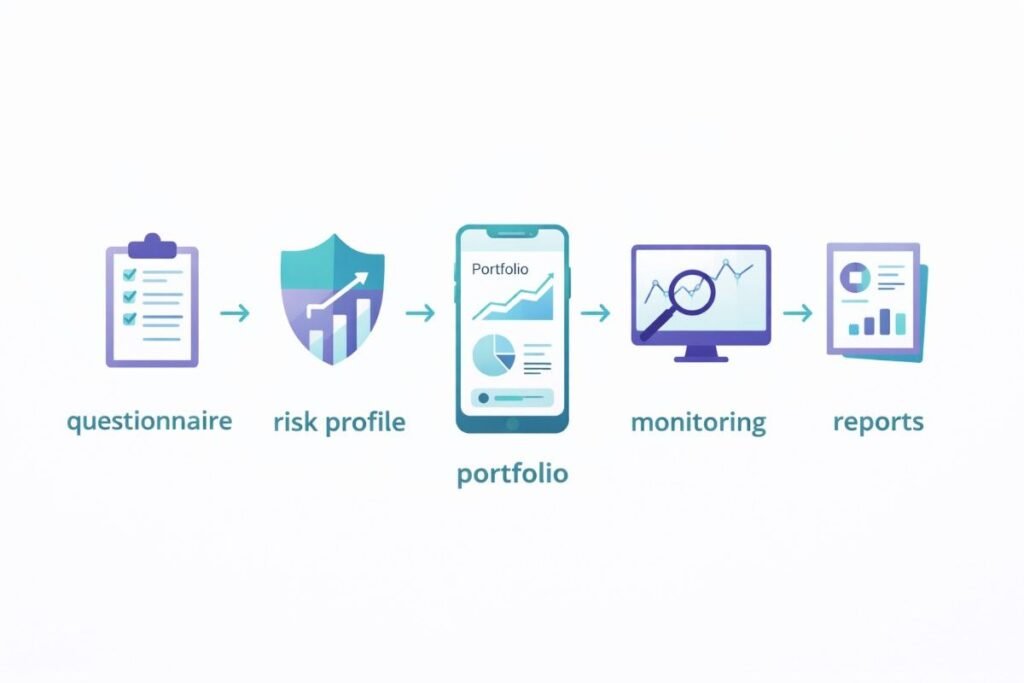
Step 1 — You answer a questionnaire. The platform asks you about your age, monthly income, financial goals (retirement, child’s education, buying a house), how long you plan to invest, and crucially — how you’d feel if your portfolio dropped 20% in a market crash. This is called risk profiling.
Step 2 — The AI builds your risk profile. Based on your answers, the algorithm places you on a spectrum from conservative (mostly debt, fixed income) to aggressive (heavy equity exposure). It does this using established frameworks like Modern Portfolio Theory, which mathematically balances expected returns against risk.
Step 3 — A portfolio is constructed for you. The platform then assesses your beta tolerance and runs a Sharpe ratio analysis to maximize returns per unit of risk, potentially allocating across Nifty 50 ETFs, corporate bonds, and gold ETFs for stability — using covariance matrices to diversify and minimize volatility. You don’t need to know what any of that means. The platform tells you: “Invest ₹5,000/month — 60% in this equity fund, 30% in this debt fund, 10% in gold.”
Step 4 — Your portfolio is monitored 24/7. Markets change. A bull run might push your equity allocation from 60% to 70%, which increases your risk beyond what you initially agreed to. The platform detects this drift automatically.
Step 5 — Automatic rebalancing kicks in. The AI nudges or automatically moves money between funds to bring your allocation back to its target. You’re notified, and in some platforms, it happens without you doing anything.
Step 6 — You receive regular reports. Monthly or quarterly, you see your returns, your portfolio health, tax-saving opportunities used, and recommendations for the next period.
The Top AI Robo-Advisors in India for 2026
India’s fintech ecosystem has grown dramatically. There are now 118 robo-advisor startups in India, of which 38 are funded and 9 have secured Series A or higher funding. Here are the platforms most suited to beginners:
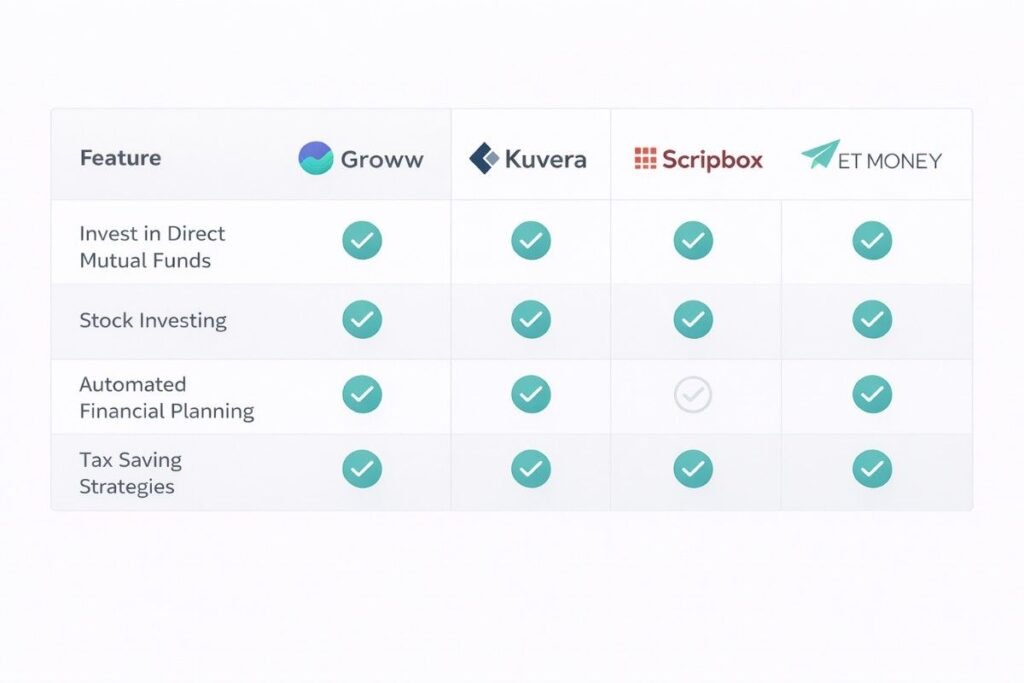
Groww One of the most downloaded investment apps in India, Groww has integrated intelligent robo-advisory features alongside its core mutual fund and stock trading platform. Its interface is arguably the most beginner-friendly in the market — you can start a SIP in under three minutes. It now uses AI to offer personalized fund recommendations based on your investment history and goals. Best for: First-time investors who want simplicity above all else.
Kuvera: A pioneer in goal-based investing, Kuvera combines advanced technology with a user-centric approach, offering tax harvesting, family account management, and risk profiling — with zero commission on mutual fund investments. Inventiva Kuvera has a particularly strong following among financially literate investors who want control over their portfolios without paying a human advisor. Best for: Mutual fund investors focused on long-term goals.
Scripbox : Scripbox was one of the earliest goal-based investment platforms in India, and it remains a trusted name. It uses evidence-based investment strategies for long-term wealth creation, offering portfolio rebalancing, risk assessment, and smart withdrawal plans. Inventiva Scripbox’s strength is simplicity — it deliberately limits the number of fund choices to avoid decision paralysis. Best for: Investors who want a “set it and forget it” experience.
ET Money (now Bajaj Finserv Markets) ET Money provides robust robo-advisory services with a focus on financial wellness, including expense tracking, tax-saving investments, and customized portfolio suggestions. Its integration of spending data with investment advice is a genuinely useful feature — the app can see that you spent ₹8,000 eating out last month and suggest channeling part of that into a SIP. Best for: Investors who want lifestyle-linked financial planning.
INDmoney INDmoney has positioned itself as a “super money app” — aggregating all your bank accounts, fixed deposits, stocks, and mutual funds in one dashboard while providing AI-driven portfolio advice. INDmoney is known for its zero-commission mutual fund investing and portfolio management tools. Anytimeinvest It also gives Indian investors access to US stocks, making it one of the more globally diversified options. Best for: Investors who want a complete financial picture in one app.
Jarvis Invest Jarvis is an AI-powered equity analytics and advisory platform that caters to both institutional and retail investors, with product offerings including portfolio management, profit and loss management, and risk management. Unlike the mutual fund-focused platforms above, Jarvis focuses specifically on direct equity investing — making it more suited to slightly more experienced beginners who want stock exposure. Best for: Investors ready to move beyond mutual funds.
Fees: What Will an AI Robo-Advisor Actually Cost You?
This is where robo-advisors genuinely shine for Indian investors.
A traditional registered investment advisor (RIA) in India typically charges 1–2.5% of assets under management annually, or flat fees that can run into tens of thousands of rupees. For someone with a ₹2 lakh portfolio, that’s ₹2,000–5,000 every year — often eating into returns significantly.
Most Indian robo-advisor platforms operate on one of three pricing models:
Zero commission / free tier — Platforms like Kuvera and Groww earn through distribution commissions from fund houses rather than charging you directly. Your returns are what you see.
Subscription model — Some premium features (advanced tax harvesting, detailed analytics, or human advisor access) are gated behind monthly or annual subscriptions, typically ₹99–₹499/month.
Percentage-based fee — A small number of SEBI-registered Investment Advisor platforms charge 0.2–0.5% of assets annually for full advisory services.
This compares to roughly 2% for human advisors — meaning a robo-advisor can save you thousands of rupees annually, which compounds significantly over time.
Tax Benefits: A Genuinely Powerful Advantage
One area where Indian robo-advisors have become increasingly sophisticated is tax optimization — and for salaried individuals, this can be a significant financial benefit.
Robo-advisors auto-suggest ELSS funds under Section 80C, letting you save up to ₹46,500 yearly on a ₹15 lakh income in the 30% tax slab. They also optimize for LTCG — capping equity gains at ₹1.25 lakh tax-free, and for HNIs, they offer tax-loss harvesting, where AI sells losing stocks to offset gains, saving thousands.
For a beginner, the practical takeaway is this: your robo-advisor will remind you every January and February that you need to invest in ELSS to save taxes under 80C, calculate exactly how much you need to invest, and route your SIPs accordingly. It’s the kind of nudge a good accountant gives you — but automated and free.
Robo-Advisor vs. Human Advisor: Which Should You Choose?
This isn’t an either/or question — it depends on where you are in your financial journey.
Choose a robo-advisor if:
- You’re just starting out and have a portfolio under ₹25 lakh
- Your investment goals are relatively straightforward (SIP for retirement, child’s education, emergency corpus)
- You’re comfortable with digital interfaces
- You want low cost and zero emotional bias in your portfolio decisions
Consider a human advisor if:
- You have complex financial needs: business income, real estate, international assets, large inheritances
- You’re going through a major life event: divorce, business sale, estate planning
- You need hand-holding during severe market downturns and want someone to talk to
The most practical option for many Indian investors in 2026 is a hybrid model. Realizing the limitations of a purely automated service, several companies are adopting a hybrid advisory model that combines robo-advisory with human support — allowing clients to enjoy the efficiency and low cost of automation while having the option to consult a human advisor for more complex needs.
Common Beginner Concerns — Answered
“Is my money safe on these platforms?” All the platforms mentioned in this article operate under SEBI’s regulatory framework. Your investments are held in your own demat account or folio — not on the platform’s balance sheet. If Groww or Kuvera shut down tomorrow, your mutual fund units would still exist in your name with the respective fund house. That said, no investment is without market risk — your portfolio can go up and down with the market, and that’s separate from platform risk.
“What’s the minimum I can invest?” Most SIP-based robo-advisory platforms allow you to start with ₹500/month. Some like Deciml and Spenny even allow micro-investments by rounding up digital payments. There is genuinely no reason to wait until you have a large corpus.
“What if I want to stop or withdraw?” You can stop your SIP, pause it, or withdraw your money at any time, subject to standard mutual fund exit loads (usually 1% if you exit equity funds within one year). The platform doesn’t lock your money.
“Can I trust an AI with my money?” Robo-advisors are devoid of emotional bias or conflicts of interest — unlike human advisors, who may push products for commission, robo-advisors make recommendations based solely on data and user preferences. The risk is that algorithms are only as good as their underlying assumptions. During unprecedented market events (like the 2020 COVID crash), even sophisticated models can underperform. Diversification and a long time horizon remain your best defenses.
What’s Coming: The Future of Robo-Advisors in India
The robo-advisory space in India is evolving quickly. Here’s where it’s heading:
Voice-first interfaces — Several platforms are piloting Hindi and regional language support, along with voice-activated SIP management. This is crucial for Tier-2 and Tier-3 market penetration.
Hyper-personalization — AI models are beginning to incorporate life event data (marriage, new job, baby on the way) to dynamically shift portfolio strategies without you having to ask.
Global diversification access — Platforms like INDmoney and Vested are making it easier for Indian retail investors to hold international ETFs alongside domestic funds, something robo-advisors are well-placed to automate.
Integration with UPI and spending data — The next generation of robo-advisors may analyze your GPay or PhonePe transaction history to recommend personalized investment amounts in real time.
As awareness about financial planning grows and digital comfort deepens, more individuals are expected to adopt robo-advisory services — with focus areas including rural and Tier-2 market penetration, making robo-advisors a viable option for underserved markets.
How to Get Started Today — A 5-Minute Action Plan
- Pick one platform — For most beginners, start with Groww, Kuvera, or Scripbox. Download the app and create a free account.
- Complete KYC — This is a one-time process using your Aadhaar and PAN. Most platforms complete it digitally in under 10 minutes.
- Fill the risk questionnaire honestly — Don’t pick “aggressive” if you’ll panic when markets fall 20%. Answer truthfully.
- Set a SIP amount you won’t miss — Start with 10–20% of your monthly take-home. You can always increase it.
- Don’t check it every day — The biggest wealth-building mistake is panic-selling during corrections. Set it, track it monthly, and stay the course.
Final Thoughts
AI robo-advisors have genuinely democratized investing in India. Five years ago, personalized portfolio management was a service available only to high-net-worth individuals willing to pay premium advisor fees. Today, a college student in Lucknow with ₹500/month has access to the same mathematical portfolio optimization that powers institutional wealth management.
They’re not perfect. They can’t replace a human advisor for complex situations, and no algorithm eliminates market risk. But as a starting point — as a tool to build the habit of investing, automate smart decisions, and grow wealth systematically — they’re one of the best financial tools available to the Indian middle class today.
The best time to start was yesterday. The next best time is now.
Also read:> Vibe coding in India: Beginners guide
7. FAQ Section
Q1: What is a robo-advisor in India? A robo-advisor in India is a SEBI-registered digital platform that uses AI and algorithms to create and manage investment portfolios — typically in mutual funds and ETFs — based on your goals, income, and risk tolerance, at a much lower cost than a human financial advisor.
Q2: Is robo-advisor safe in India? Yes, when using SEBI-registered platforms. Your money is invested directly in your name through regulated mutual funds or demat accounts. Platform risk (the company shutting down) is separate from your investment, which remains in your name with the fund house.
Q3: Which is the best robo-advisor in India for beginners? For absolute beginners, Groww and Scripbox are the most user-friendly options. Kuvera is excellent for mutual fund-focused investors wanting zero commission. INDmoney suits those who want a complete financial picture in one app.
Q4: How much does a robo-advisor cost in India? Most platforms are free or near-free for basic features. Advanced tools may cost ₹99–₹499/month. Even paid plans typically cost 0.2–0.5% of assets annually — significantly less than human advisors, who typically charge 1–2%.
Q5: Can a robo-advisor save me tax in India? Yes. Most Indian robo-advisors automatically recommend ELSS funds for Section 80C deductions (up to ₹1.5 lakh/year), optimize for Long-Term Capital Gains (LTCG) tax exemptions, and some offer tax-loss harvesting features for advanced users.
Q6: What is the minimum investment for a robo-advisor in India? Most platforms allow SIPs starting at ₹500/month. Some micro-investment platforms allow even smaller amounts through round-up features linked to UPI payments.
Q7: Is robo-advisor better than a human financial advisor in India? For straightforward goals (retirement SIP, tax saving, emergency fund), robo-advisors offer better value — lower cost, no bias, 24/7 availability. For complex situations (business succession, estate planning, large real estate portfolios), a human advisor is still recommended, ideally combined with a robo-advisory platform.