
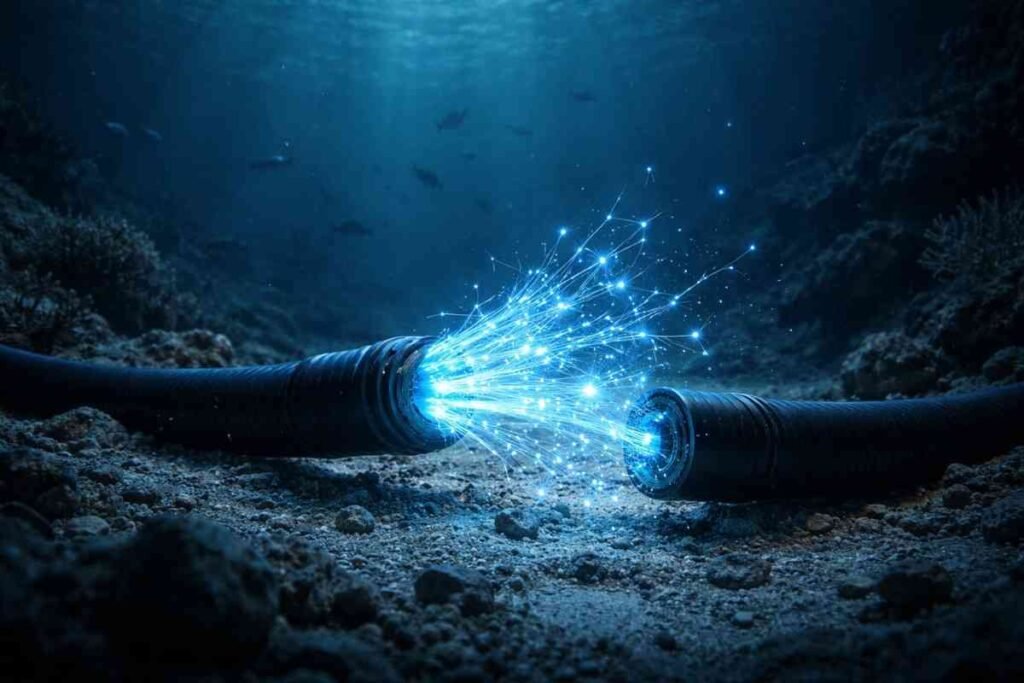
The geopolitical tension between Iran, the US, and Israel has moved beyond conventional borders and into the deep-sea trenches of our digital world. With the of undersea fiber-optic cables being severed in the Red Sea and Strait of Hormuz, we face a potential “digital dark age.”
For the common person, this isn’t just about losing social media; it’s about the potential paralysis of banking, UPI, and critical work infrastructure. Surviving a total internet outage requires more than just patience—it requires a strategic “Local-First” transition. By diversifying your financial buffers, securing offline communication mesh networks, and caching essential survival data, you can maintain personal and professional continuity even when the grid fails.
The Fragility of the Global Web: A 2026 Reality Check
The internet is often perceived as a cloud-like, ethereal entity, but it is physically grounded by thousands of miles of undersea cables. These cables are the literal arteries of global commerce and communication, carrying over 95% of all international data traffic. In the Red Sea and the Strait of Hormuz, these “chokepoints” are incredibly vulnerable to sabotage or collateral damage during military conflicts.
In early 2026, the suspension of major cable projects like 2Africa Pearls due to regional conflict has highlighted this fragility. If these cables are cut, the world doesn’t simply go dark in an instant. Instead, traffic is rerouted through longer, more congested paths. For the average citizen in India or the Middle East, this means extreme latency—a “slow-motion” internet where critical services fail to load, and international pings time out.
To tackle this, we must stop viewing the internet as a permanent utility like gravity and start treating it as a fragile resource that requires a personal and community-level backup plan.
Financial Resilience: Moving Beyond the UPI Bubble
India’s digital payment revolution is a marvel of the modern world. However, its Achilles’ heel is its total and absolute dependence on real-time connectivity. Every UPI transaction requires a “handshake” between your phone, your bank’s server, the NPCI gateway, and the recipient’s bank. If the undersea “arteries” are disrupted, this handshake fails.
The Seven-Day Cash Buffer
The most immediate step for every household is to maintain a physical cash reserve. While we have moved toward a cashless society for convenience, physical currency remains the only medium of exchange that does not require a server. Aim to keep enough small-denomination notes to cover seven days of essential supplies like milk, bread, medicines, and fuel. This “buffer” is your first line of defense during a network collapse when ATMs and QR codes stop responding.
Transitioning to SMS and USSD Banking
Most people have forgotten that banking existed before smartphones and high-speed 5G. Every major bank supports USSD banking (dialing *99# in India) and SMS-based inquiries. These services run on the GSM signaling layer rather than the data layer. In many scenarios where 4G or 5G data is throttled or cut, basic cellular signals for calls and texts remain operational. Familiarize yourself with these codes today and save them in your physical notebook for emergency transfers.
Case Studies: Learning from Past Disruptions
To understand the impact of an outage, we must look at recent history. During the internet shutdowns in Myanmar (2021) and parts of Ethiopia (2020-2022), the population was forced to adapt instantly.
In Myanmar, when mobile data was cut, citizens relied on “offline-first” apps and physical mesh networks to coordinate. In Sudan, people used old-fashioned FM radio to share news of where food and water were available. These examples show that the human spirit is resilient, but those who had pre-downloaded maps and medical data fared significantly better than those who relied entirely on the cloud.
Communication Without the Grid: The Mesh Network Revolution
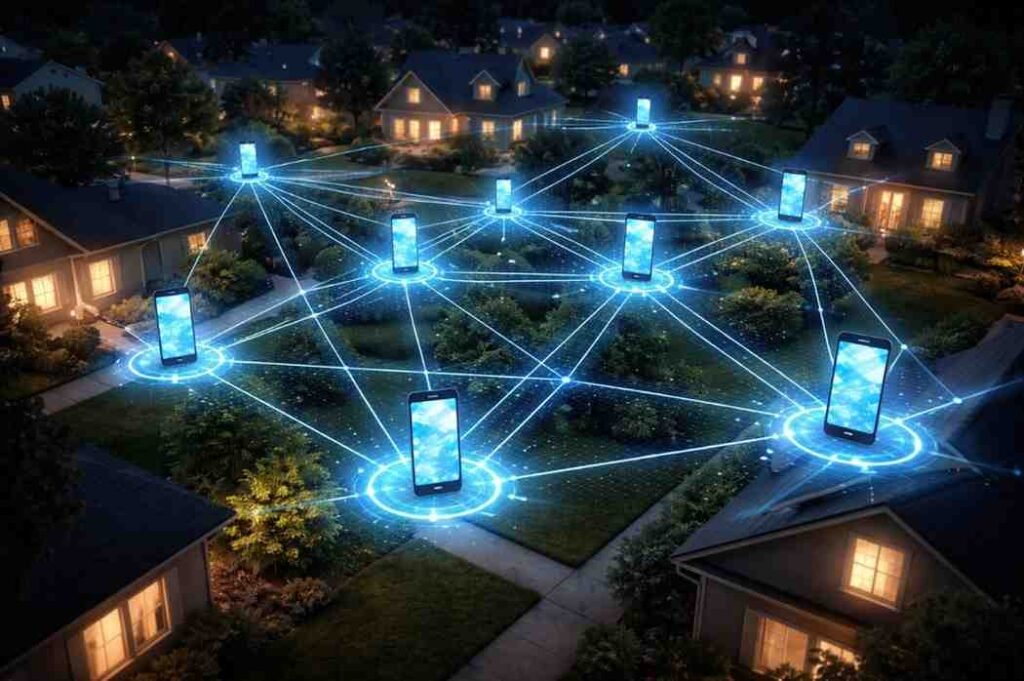
When the central servers of WhatsApp or Telegram are unreachable, your smartphone still possesses powerful hardware: Bluetooth and Wi-Fi antennas. These can be used to create “Mesh Networks.”
Bridgefy and Briar: The New Essentials
Apps like Bridgefy use Bluetooth to send encrypted messages from one phone to another. If a neighborhood has enough people with the app installed, messages can “hop” from one device to the next until they reach the recipient. This turns a local community into its own self-contained communication grid. For the masses, this is the single most important digital tool to install before an outage occurs, as it requires no towers or satellites.
The Return of the Battery-Powered Radio
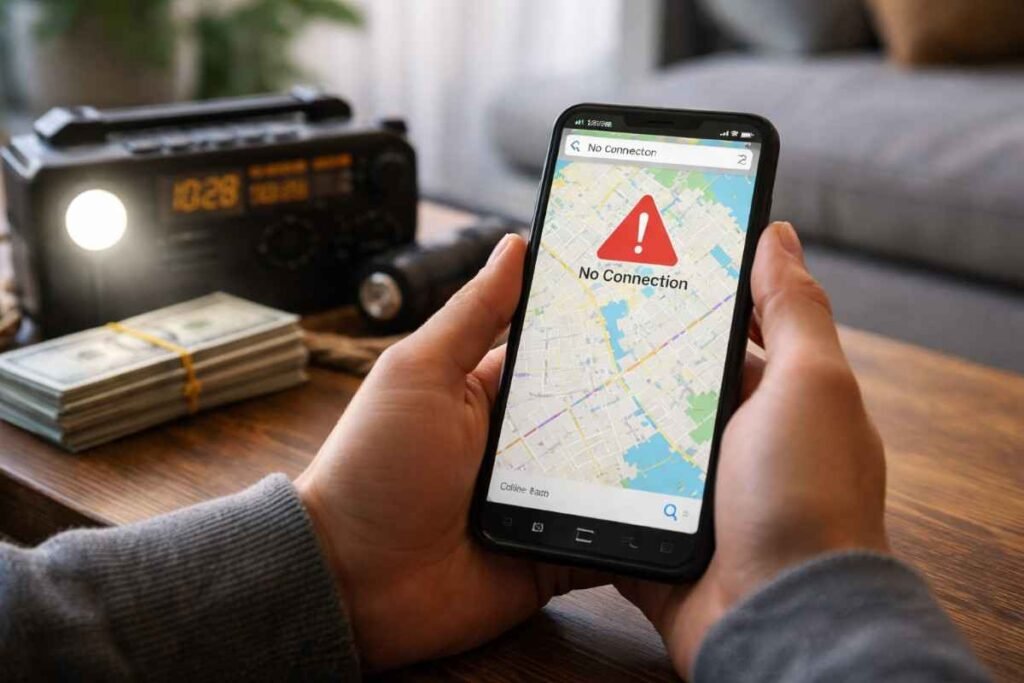
In every major historical conflict, the radio has been the ultimate survivor. A simple FM/AM radio powered by AA batteries or a hand crank is essential. During a national emergency or a total internet blackout, governments will use terrestrial radio frequencies to broadcast official instructions, safety warnings, and news. It is a one-way communication tool that cannot be “hacked” or “cut” by a submarine.
Step-by-Step Guide: Setting Up Your Offline Library
To reach true digital sovereignty, you need to store the world’s knowledge on your device. Here is how to set up the most critical tools.
1. Kiwix: The Knowledge Vault
Kiwix allows you to download compressed versions of entire websites.
- Step 1: Download the Kiwix app from the Play Store or App Store.
- Step 2: Go to the “Online” tab and search for “WikiMed.” This is the entire medical portion of Wikipedia.
- Step 3: Download “WikiMed” and “Wikihow.” This will take about 5-10GB of space.
- Step 4: Once downloaded, turn off your internet and try searching for “How to treat a burn.” If the article loads, your vault is ready.
2. OsmAnd: Professional Grade Offline Maps
Unlike Google Maps, OsmAnd is built for the offline world.
- Step 1: Install OsmAnd from the app store.
- Step 2: Open the “Download Maps” menu.
- Step 3: Select “Asia” -> “India” -> “Uttar Pradesh” (or your specific state).
- Step 4: Enable the “World Overview Map.” This ensures you have basic navigation even outside your downloaded region.
- Step 5: Download “Contour Lines” and “Hillshade” layers if you live in a hilly area.
Protecting the Professional: Remote Work and Data Continuity
For bloggers, developers, and online workers, an internet cut is a direct threat to livelihood. The strategy here is “Data Sovereignty”—ensuring your work lives on your hardware, not just the cloud.
Local-First Productivity Tools
If you rely on Notion, Google Docs, or Canva, you are at risk. Professional writers should transition to local-first editors like Obsidian, Logseq, or traditional Microsoft Word (with local saving enabled). These tools ensure that your work stays on your hard drive. Once the connection returns, you can sync your progress, but your productivity never stops during the outage.
Physical Backups and Hardwired Contacts
Cloud storage is a convenience, not a backup. Maintain a high-speed external SSD with your active projects. Furthermore, do not rely on your email or LinkedIn to reach clients. Save their phone numbers and physical office addresses. In a crisis, an international phone call or an SMS is far more likely to go through than a Slack message.
Community Leadership: Organizing Your Neighborhood
If you are a community leader or a tech-savvy individual, you have a responsibility to help your neighbours. In a total outage, a “Neighbourhood Mesh” can be the difference between chaos and order.
Organizing a Mesh Protocol
Encourage everyone in your building or street to install Bridgefy. Create a “Communication Tree” where each person is responsible for checking on two neighbours. Use the mesh network to share local news, such as “Milk has arrived at the local store” or “The water pump is fixed.” This reduces panic and keeps the community functional without external help.
Shared Knowledge Hubs
If you have a laptop with a large hard drive, download the full Wikipedia ZIM file (about 90GB). You can act as a local “Information Hub.” People can come to you to look up technical fixes or medical advice, which you can then share via the local mesh network.
Undersea Cables: How They Are Fixed and Why It Takes Time
Understanding the repair process helps set realistic expectations. Repairing a subsea cable requires specialized “Cable Ships.” These ships must navigate to the exact GPS coordinate of the break, drop a hook to catch the cable, pull both ends to the surface, and splice them back together in a sterile laboratory environment on the ship.
In a war zone, cable ships cannot operate safely. If the conflict between Iran and Israel escalates, these ships may be blocked from entering the Red Sea for months. This means a “temporary” cut could lead to a long-term digital slowdown. Preparedness is not just for a few days—it is for a prolonged period of friction.
2026 Readiness: The Community Infrastructure Checklist
For the common person to survive a digital siege, the following physical preparations are non-negotiable:
- Dual-SIM Strategy: Use two different network providers. If one company’s subsea gateway is damaged, the other may have a different routing path through land-based lines (e.g., through Central Asia).
- Solar Charging: A smartphone with no battery is useless. A small, portable solar charger can keep your “offline library” and communication tools running indefinitely if the power grid also fails.
- Fuel and Medicine: Petrol pumps and pharmacies rely on digital inventory and payment systems. Keep a 30-day supply of prescriptions and keep your vehicle’s fuel tank above the halfway mark.
- Hard-Copy Contacts: Print a list of phone numbers for family, doctors, and local authorities. Do not rely on your phone’s contact list if the battery dies or the screen breaks.
Conclusion: Preparation Over Panic
The possibility of a total internet outage due to the Iran-USA-Israel conflict is a serious contingency that requires a calm, methodical response. Technology should be a tool we use, not a tether we cannot survive without. Shifting to a “Local-First” lifestyle isn’t about moving backwards; it’s about building a layer of resilience that makes you unshakeable in the face of global instability.
Start your preparations today. Download your maps, secure your cash buffer, and install mesh communication apps. It is better to have a plan you never need than to need a plan you never made. By becoming digitally self-sufficient, you ensure that no matter what happens under the sea, your world keeps moving forward.
Frequently Asked Questions (FAQ)
Can the internet be completely shut down globally? Technically, no. The internet is a decentralised “network of networks.” However, regional shutdowns or severe slowdowns are possible if major subsea cables in the Red Sea or Atlantic are damaged.
Will my UPI work if the internet is slow? UPI requires a stable connection to verify the transaction. In a severe outage, UPI is likely to fail or time out, making cash the only reliable option for daily needs.
Do offline maps still show my location? Yes. GPS is a satellite-based system that operates independently of the internet. As long as you have the map data downloaded to your phone, your location will still appear accurately.
How can I message people if WhatsApp is down? You can use Mesh Network apps like Bridgefy or Briar, which use Bluetooth and Wi-Fi Direct to send messages directly from phone to phone within a limited range.
Is Kiwix free to use? Yes, Kiwix is an open-source project and is completely free. You only need to pay for the storage space (SD cards or hard drives) to hold the data.